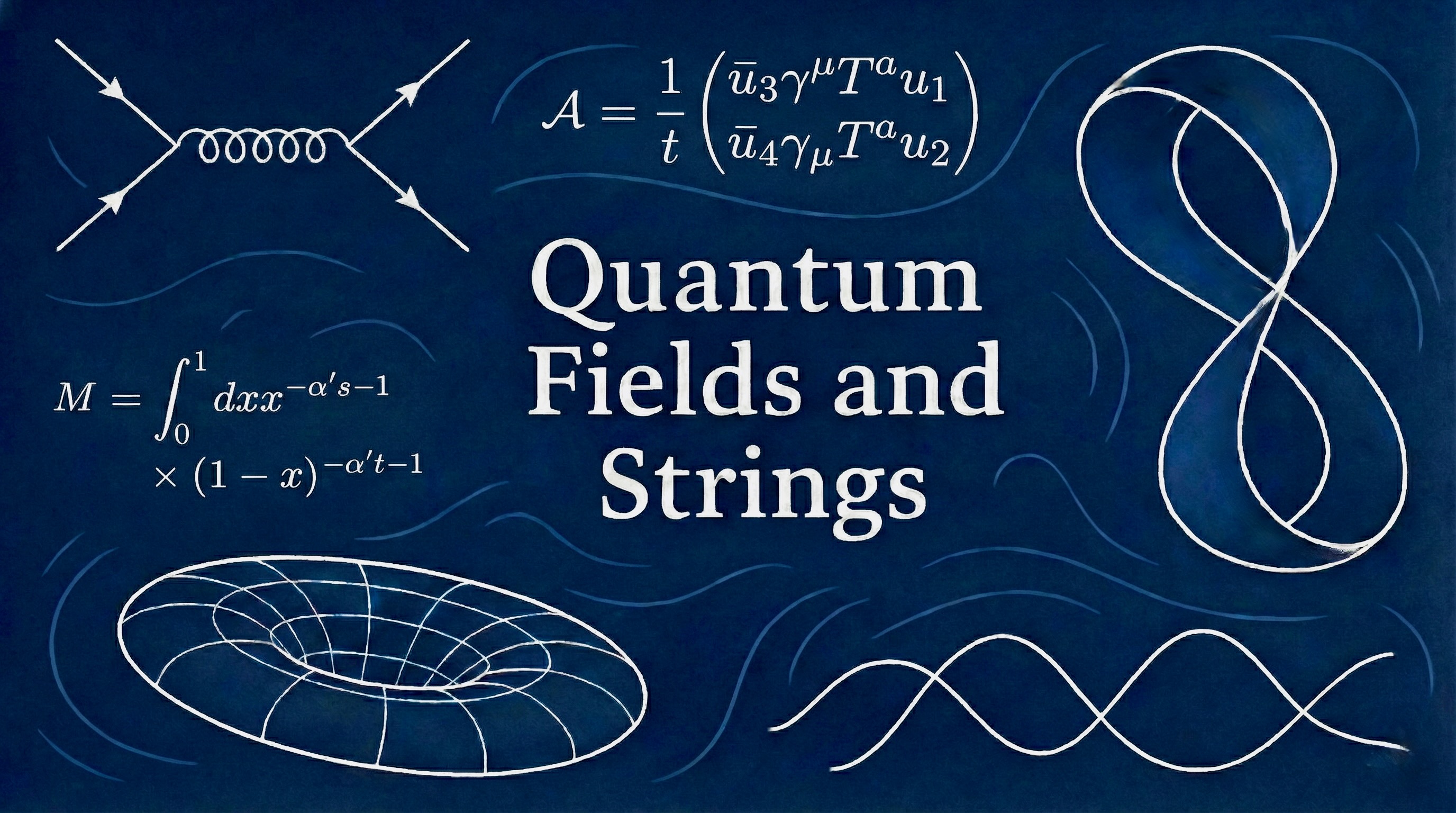
Quantum Fields and Strings Group
Welcome to the Quantum Fields and Strings Group.
Our group conducts research in Quantum Field Theory (QFT) and String Theory, with a primary emphasis on understanding the analytical properties and mathematical structures of Scattering Amplitudes.
We aim to uncover the deep mathematical structures governing fundamental interactions, develop new analytic and geometric frameworks, and apply these insights to problems in field theory, gravity, and string theory.
Why should we study scattering amplitudes?
- Scattering amplitudes are derived objects within the framework of QFT, serving as a bridge between theory and experiment. Experimentally, people care about measurable physical quantities, while theoretically we are used to computing quantities that are accessible to established methods. Scattering amplitudes form this bridge: they can be computed theoretically, and after further processing (such as taking the modulus squared, summing over quantum numbers, integrating over phase space, etc.), they yield theoretical predictions for experimentally observable quantities (such as differential cross sections, decay rates, and so on).
- Scattering amplitudes are the consequence of fundamental principles of quantum field theory (such as unitarity and locality), and studying them helps us explore the core structure of QFT itself. Traditionally, QFT is approached from the Lagrangian, followed by quantization (canonical or path-integral), and then perturbative computation of amplitudes using Feynman diagrams. However, the number of Feynman diagrams grows rapidly with particle multiplicity, making amplitude computations increasingly difficult. This motivates an alternative approach—abandoning lengthy Feynman-diagram calculations and instead using fundamental principles directly to compute amplitudes. This conceptual shift has been one of the major developments in scattering amplitudes in the past two decades.
- Rich and surprising mathematics lies behind scattering amplitudes. It is astonishing that a seemingly small subfield of QFT can connect to a broad range of mathematics—including residue theorems in complex analysis, intersection numbers in topology, Hopf algebras, computational algebraic geometry, positive geometry, and more. Research on amplitudes has stimulated progress in mathematics, while mathematics itself has become deeply rooted in the study of amplitudes.
Research Areas
Our group’s research interests mainly focus on various aspects of scattering amplitudes in quantum field theory and string theory, including:
-
Hidden Properties and Relations of Scattering Amplitudes
-
Color-Kinematics Duality and Double Copy
-
String Amplitudes & Worldsheet Formula
-
Geometry Behind Scattering Amplitudes
-
Observables in Curved Spacetime
Learn more on the Research page.
News & Updates
- 2025-12-5 — Open Call for Postdoctoral Researchers! https://inspirehep.net/jobs/3089527
- 2025-12-1 — Website launched!
Selected Publications
A selection of recent papers from our group:
-
Form Factors from String Amplitudes
Q. Cao, Phys.Rev.Lett. 135, (2025) 021603.
arXiv:2504.15602 -
Surface Kinematics and the Canonical Yang-Mills All-Loop Integrand
N. Arkani-Hamed, Q. Cao, J. Dong, C. Figueiredo and S. He, Phys. Rev. Lett. 134, (2025) 171601.
arXiv:2408.11891 - Scalar-scaffolded gluons and the combinatorial origins of Yang-Mills
theory
N. Arkani-Hamed, Q. Cao, J. Dong, C. Figueiredo and S. He, JHEP 04, (2025) 078.
arXiv:2401.00041 - Hidden
zeros for particle/string amplitudes and the unity of colored scalars
N. Arkani-Hamed, Q. Cao, J. Dong, C. Figueiredo and S. He, JHEP 10, (2024) 231.
arXiv:2312.16282 - Constructibility of AdS Supergluon
Amplitudes
Q. Cao, S. He,and Y. Tang, Phys. Rev. Lett. 133 (2024) 021605 arXiv:2312.15484
See full list on the Publications page.
Group Members
We are always looking for highly motivated students and collaborators with interest in QFT, String theory, and amplitudes.
See details on the Members page.
Conferences
Upcoming and recent meetings related to scattering amplitudes and string theory are listed here:
See more on the Conferences page.
Useful Links
If you are interested in collaboration or joining our group, feel free to reach out.
We welcome students with strong interest in quantum field theory, string theory, and mathematical physics.